
Here is something I have been thinking about lately. Most of us move through the day without noticing the small things. The air when the windows have been shut for a week. The cleaning spray under the sink. That candle you light most evenings without thinking. The plastic container you keep reheating leftovers in for the third time this week.
On their own, none of these seem like a big deal. And honestly, they probably are not. But when you do them every single day, week after week, they start to add up.
That accumulation is what people mean by your daily toxic load. The background hum of chemicals, habits, and environmental inputs your body has to process constantly. Most of us never really think about it. We use the products, fall into the routines, and all the while our bodies carry that weight in the background.
Look, I am not saying panic. Please do not panic. You do not need to throw everything out tonight. But it is worth pausing to actually see what is taking up space in your home. What touches your skin. What sits in your kitchen cabinets. What shapes the air you breathe. Because once you start seeing those patterns, it gets easier to make small choices about what stays and what might be worth swapping out.
The good news? You do not have to go extreme or spend a lot. Most of it is just small shifts. Rethinking what you bring through the door. Noticing what ends up in your hands day after day. Little changes like that change how your home feels.
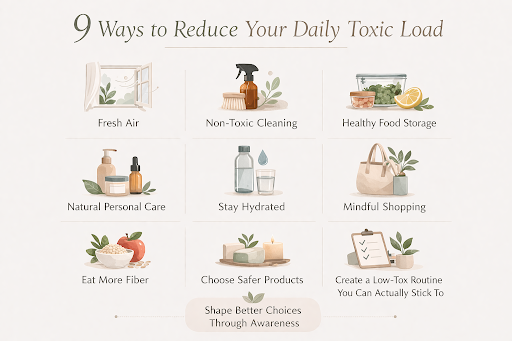
So in this article, we will walk through nine practical ways to lighten the load at home. Nothing overwhelming. Just easing up on exposures that have quietly become normal. The goal is not perfection. Just a home that feels cleaner, more intentional, and less full of things that do not belong there.
What Does “Toxic Load” Actually Mean and Why Daily Exposure Matters
A Simple Way to Understand Toxic Load
Toxic load is just a name for something pretty straightforward. It is the mix of everyday exposures your body deals with on a regular basis. The air you breathe. The food and water you take in. The stuff you put on your skin. The things that enter your home through cleaning products, plastics, cookware, fragrance, all of it.
It is not about pointing at one single thing and calling it the enemy. It is about the bigger picture. The total environment you move through every day. The small inputs that add up without you ever noticing.
Why the Everyday Choices Count
What really shapes your environment is rarely one dramatic event. It is the stuff that happens on repeat. The spray you hit the counters with every morning. The container you keep reaching for when leftovers need a home. The scent hanging in a room with the door shut. The products you layer on before you even leave the house.
Those regular touchpoints? They quietly become part of your exposure pattern. The National Cancer Institute puts it pretty directly. Cancer prevention means avoiding exposure to probable and known carcinogens and endocrine disruptors where you can. (1) Not just in rare, obvious situations. In the everyday stuff.
That is also why change does not have to be extreme to matter. The shifts that last are usually the ones that fit into normal life without a lot of effort. Learning to lighten your toxic load often starts small. A few adjustments here and there until your home starts to feel cleaner, more intentional, just generally easier to live in.
1. Start With the Air You Breathe
If you want to start somewhere simple but real, start with the air in your home.
Most of us spend hours inside every day and never think about what we are actually breathing. But you can tell when something is off. A room feels heavy. Dinner smells still hang around the next morning. That candle you lit last night left its scent sitting there long after you stopped noticing it. The windows stay shut, the air goes stale, and it all becomes background noise your body deals with whether you realize it or not. That is why indoor air is such a good place to begin. You do not need an overhaul. In most homes, a few small shifts can change how a room feels surprisingly fast.
Here are some that actually help:
- Open the windows. Even just a few minutes in the morning. It clears out that closed-up, heavy feeling better than anything you can buy in a bottle.
- Run the fan when you cook. Switch it on before you start, not after. Or crack a window nearby so smoke and steam do not just settle into the kitchen for hours.
- Cut back on synthetic fragrance where you can. Air fresheners, scented sprays, those plug-in things, heavily perfumed candles. They leave a constant layer of scent in the background that you stop smelling but your lungs do not.
- Pay attention to smoke. Cigarettes, wood-burning, cooking smoke that builds up faster than people realize. It all lands somewhere.
- Think about air filtration if your home traps dust or outdoor pollution. Or if cleaner air is something you just want to prioritize.
- Grow a few plants. About one per hundred square feet helps. They pull stuff out of the air you did not even know was there, plus they make the space look better.
Quick win: Pick one heavily fragranced thing in your home this week and just remove it. See how the space feels without it.
2. Reassess Your Cleaning Products
Cleaning products are one of those places where stuff piles up without anyone really noticing. One spray for counters, another for the bathroom, something for glass, something for floors, an air freshener to cover up the smell of all the others. Before you know it, the space under your sink looks like a chemical storage unit and you are using most of it on autopilot.
Here is why that matters. These are products you use in the rooms you live in most, on surfaces your hands touch constantly, often with little ventilation. The goal is not to drop a bunch of money on a perfect “non-toxic” cupboard overnight. Just open the cabinet you already have and be honest about what is in there. Most households do not need nearly as many products as they own. Half of them probably do the same thing, adding clutter and synthetic fragrance without you ever stopping to question it.
So here are a few shifts that actually help:
- Pull everything out from under the sink. Group similar stuff together. You will probably realize pretty fast how much overlap is sitting there.
- Cut back on what you do not actually use. Be honest. Some of those bottles looked useful at the time. They were not. Let them go.
- Simplify instead of replacing everything at once. The goal is not a perfect cupboard by Sunday. It is just stopping the habit of layering in more than your home actually needs.
- Pay attention to ingredient labels. Especially on stuff you use regularly in closed-up spaces like bathrooms and laundry rooms where fumes just sit there.
- Watch for heavy fragrance. A strong “clean” smell is not the same thing as a cleaner home. Half the time it just means there is another layer of something sitting in the air long after you have finished wiping things down.
- Choose certified organic products. It eliminates the majority of toxic chemicals in one move without you having to become a chemist.
Quick win: Give yourself fifteen minutes this week to pull everything out, spot the duplicates, and pick one everyday cleaner to actually look at before you buy it again.
3. Upgrade Food Storage and Prep Habits
The kitchen runs on tiny habits you barely notice anymore. Leftovers packed away, the same container grabbed for lunch, food reheated in whatever is handy. None of it feels like a big deal. And that is exactly why it is worth a second look. What happens in your kitchen every day becomes background exposure before you realize it is there.
This is not about replacing everything in one weekend. It is just looking at what you touch most often, especially when heat is involved. That cloudy old container. The plastic lid that has seen one too many microwaves. The pan you reach for daily without checking if the coating is still intact. You ignore them simply because they have been there forever.
Here are the shifts that matter:
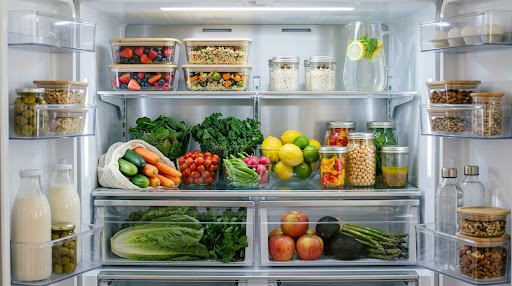
- Replace plastic containers. Especially the old, worn, scratched stuff. The ones that have been through heat. Go for glass or stainless steel instead. They last longer anyway.
- Stop reheating food in plastic. That is probably the easiest habit to change and one of the most worth it. Transfer to a plate or bowl before you hit start.
- Take a look at your everyday cookware. The pans you use most. Are they still in good shape? Or are they chipped, scratched, just kind of hanging on because you are used to them?
- Store food more intentionally. Not fancy, just sturdier. Cleaner options for the stuff you prep and reheat all the time.
- Wash produce thoroughly. Make it part of the routine, not an occasional extra when you remember.
Quick win: Pick one old plastic container this week, the one that has seen better days, and swap it for something sturdier you will actually use.
4. Take a Tighter Look at Personal Care and Beauty Products
Your bathroom shelf looks harmless because everything on it feels so normal. Body wash, deodorant, moisturizer, sunscreen, all the stuff you use without thinking. None of it feels extreme because it is just your routine. But that is exactly the point. These are not one-off exposures. They are products you use over and over, often every single day, and most of them sit on your skin for hours.
That makes personal care one of the most direct places to look when you are trying to lighten your toxic load. You buy the same things because you always have. You reach for them without reading labels. The good news is you do not need to empty every drawer and start over. Just begin with what you use most often, the products that cover the most skin or stay on the longest. That is usually where the biggest patterns are hiding.
Here is where to start:
- Check your daily-use stuff first. Deodorant, moisturizer, body lotion, sunscreen, cleanser. The things that touch you every single day.
- Watch out for “fragrance” on labels. Especially in products that sit on your skin for hours. That one word can hide a lot.
- Look for organic ingredients. It sidesteps most of the toxins without you having to memorize a list of what to avoid.
- Swap gradually. Let things run out, then replace the worst ones first. You do not need to do it all in one trip to the store.
- Simplify where you can. A shorter routine often means fewer layers of stuff you did not really need in the first place.
Quick win: Grab the three products you use most often and actually read the ingredients before you buy any of them again. Just see what is in there.
5. Be More Selective With What You Bring Into Your Home
Sometimes the problem is not what you are actively using. It is just what is there. The scented garbage bags you never actually picked out. The “odor-eliminating” spray sitting by the door. The dryer sheets leaving a layer of something on every towel. The non-stick pan, the plastic pitcher, the fragrance beads in your laundry. These things do not announce themselves. They arrive, get unpacked, and slowly become part of the background until you stop noticing them at all.
That is why this matters. Your home is shaped by what keeps walking through the door. Once something is inside, it gets normal fast. You stop smelling the scent. You stop questioning the material. So slow down before you buy. Not everything marketed as fresh or convenient deserves a spot in your house. A lot of it is just extra. Extra fragrance. Extra coating. Extra exposure you did not ask for.
Here are a few filters that help:
- Skip the fragranced stuff. Candles, room sprays, plug-ins, scent boosters. They are not making your home cleaner, just smellier. If you want something that smells nice, go with essential oils.
- Avoid plastics. Especially for things that hold food or water. It leaches, it wears down, and it is almost never the best option.
- Question the coated stuff. Non-stick pans, stain-resistant fabrics, anything treated to repel things. They usually come with trade-offs you cannot see. Cast iron, stainless steel, and ceramic do the job without the coating.
- Choose fewer things. Not in a minimalist, get-rid-of-everything way. Just in a “do I actually need this?” way. One good item beats five that looked appealing in the moment but do not really add anything.
- Read labels when you can. Especially on things meant to scent the air or sit close to your skin. You do not have to understand every word, but you will start to notice patterns.
Quick win: Next time you are about to buy something for your home, pause and ask yourself one question: does this actually do something useful, or is it just adding more stuff to the background?
6. Support Your Body’s Natural Detox Pathways With Daily Habits
A cleaner home matters. But that is only half of it.
The other half is your body itself. And whether you are giving it the kind of support it actually knows what to do with.
Because here is the thing about all the detox talk out there. Your body is not sitting around waiting for a cleanse or a fancy juice reset to save it. It already has its own system. Digestive tract, liver, kidneys, lungs. That is the real detox setup. And according to places like MD Anderson, the stuff that actually supports it long-term is not extreme. It is just healthy habits. Eating well. Moving your body. The boring stuff no one makes a documentary about. (2)
Here is what that looks like:
- Drink water. Not a complicated amount. Just more than you probably are right now. Your body needs it to function.
- Eat fiber. It supports digestion and keeps things moving the way they should. Vegetables, beans, whole grains. The stuff that actually grows.
- Move regularly. Walk, stretch, lift things, whatever you can actually stick with. Your body was not designed to sit still all day.
- Prioritize sleep. So much of the recovery work happens when you are asleep. Do not shortchange it.
- Find a way to dial down stress. Not forever, just regularly. Because feeling constantly run down makes every other habit harder to keep up.
Quick win: Pick one thing this week. More water. One fibre-rich meal. A short walk. Just one. See how it feels.
7. Don’t Overlook Lifestyle Exposures
Some exposures do not come in a bottle or sit under your sink waiting to be swapped out. They just show up in the rhythm of your week. The glass of wine that turned into two or three because that is what evenings look like now. The cigarette that is still there even though you have meant to quit for years. The bar where the air is thick enough you smell it on your clothes afterward. These are not products you bought because the marketing was good. They are habits. And habits are harder to look at than shopping lists, because changing them does not start with a trip to the store. It starts with deciding something about how you actually live.
The National Cancer Institute puts alcohol and tobacco right there on the list of well-studied cancer risk factors. (3) Not buried in fine print. Just out in the open. Which means if you are going through your life trying to clean things up, these deserve more than a passing glance.
So here is the question that matters more than “what should I buy instead?” What is showing up regularly in your life that has started to feel normal just because it happens all the time?
Not everything harmful feels dramatic. A lot of it just feels familiar.
Here is where to look:
- Pay attention to alcohol. Not in a “never drink again” way. Just notice if it has shifted from occasional to regular without you deciding that.
- Avoid smoking and secondhand smoke. It outweighs most of the household stuff people fixate on first. By a lot.
- Notice the repeated stuff. Poor air. Fumes. Irritants that keep showing up. The things that happen often, not just the things that feel dramatic.
- Focus on what actually moves the needle. It is easy to get distracted by small details that feel productive but do not change much. Start with the habits that matter most.
Quick win: Pick one routine habit you know is not doing you any favors. Just one. And think of one realistic way to start shifting it this week.
8. Create a Low-Tox Routine You Can Actually Stick To
Here is the part that usually trips people up.
You read through a list like this and feel motivated. You imagine your home feeling cleaner, simpler. Then Tuesday arrives and suddenly the gap between “inspired” and “actually doing it” feels massive.
That gap is where most good intentions go to die. Not because the changes are hard, but because they did not fit your actual life.
So instead of another list of swaps, ask yourself: what does a realistic version of this look like for me?
- Maybe you do better going all in on one area at a time. Clear out the bathroom cabinet in an afternoon and be done with it. That works.
- Maybe you need to let things run out naturally and replace them slowly. That works too.
- Maybe your partner could not care less, so every change has to be invisible. Work around it.
- Maybe your budget only allows one swap a month. Great. That is twelve things this year.
The point is not to follow someone else’s blueprint. It is to find a rhythm that does not collapse the moment life gets busy. The only rule that matters is making it easy enough to keep doing. If it feels overwhelming, you are trying to do too much. Scale back. A low-tox home is not built in a weekend. It is the cleaner you replace when the bottle runs out, the container you finally swap, the lotion you stopped buying after one look at the label. That is how this sticks. Not perfection. Just small changes that actually fit your life.
Quick win: Forget what anyone else is doing. Ask yourself one question: what is one change I could actually live with long enough for it to become normal? Start there.
9. Let Awareness Shape Better Choices
At some point, this stops being about products and starts being about how you see your home.
You start noticing what is always there. The plug-in air freshener in the hallway you stopped smelling months ago. The non-stick pan you reach for every morning without checking if the coating is still intact. The laundry detergent that leaves your clothes smelling like a garden you have never actually seen. What stays not because you chose it, but because you never un-chose it. And once you really see them, you cannot unsee them.
That is not paranoia. It is just paying attention.
And paying attention changes things more than any purge ever could. Not because you suddenly become perfect, but because you stop shopping on autopilot. You pause before buying something just because the packaging is pretty. You read labels not because you are obsessed, but because you got curious once and now it is just part of how you buy stuff.
That is where healthier homes actually get built. Not in one dramatic weekend. In the quiet moments where you stop and think, do I actually want this in my house?
Quick win: Next time you grab an everyday product, stop for ten seconds. Read the label before it goes in your basket. Just see what is in there.
Final Thoughts: A Healthier Home Starts With Everyday Choices
None of this is about fear. It is about pulling back the curtain on what you have been walking past every day. The things that migrated into your cart without ever being chosen. The habits you never question. Real change does not require a manic weekend with garbage bags. It happens in the pauses. The moment you hold something and ask, does this still make sense here?
Start where the exposure is highest. One swap. One habit you reshape. One corner of your home that finally matches how you want to feel. Small moves win because they survive past Thursday.
But here is something most people do not realize: Reducing your toxic load is only part of the equation. Because even if you clean up your environment, there are still deeper factors inside the body that can keep inflammation high and allow disease to take hold.
Chronic stress doesn’t just exhaust you; it actively disrupts your digestion, immune response, and nervous system, leaving your body too overwhelmed to properly filter out the environmental toxins we face daily. This is why we help clients get to the root cause of their stress and help their nervous system heal and regulate through the Awaken Process.
To help you better understand this, I created a complimentary guide called:
The Essential How-To Guide to Detoxing Cancer Cells

Inside, you will discover:
- How your body’s natural detox systems support your defense against cancer
- Why many detox approaches fall short when it comes to long-term support
- The hidden factors that can block your body’s detox pathways and what you can do to support them naturally
- Simple daily habits to help your body clear toxins more effectively
- How reducing your toxic load can help create a stronger foundation for long-term health
When you understand how your body actually works, you stop guessing and start making decisions that support your health.
Download your complimentary copy here and start supporting your body the right way.