

Most people think they know what raises cancer risk.
They think of the usual suspects: smoking, genetics, alcohol, processed food, too much sun. The obvious things. The things we’ve been warned about for years.
But some risk factors don’t come with that same clear, familiar label.
They’re quieter than that.
They tend to sit in the background of everyday life, woven into routines, environments, and exposures so familiar that they barely register. Not dramatic enough to trigger alarm. Not visible enough to demand attention. Easy to miss precisely because they don’t feel unusual.
And that may be part of the problem.
Because when something becomes part of the backdrop, we tend to stop questioning it. We stop noticing it. Yet cancer risk has never been a one-lane conversation. Alongside genetics and lifestyle, science has also spent years examining the role of environmental exposure and the cumulative ways the world around us can shape long-term health.
That doesn’t mean panic is useful. It doesn’t mean everything around us is dangerous. And it definitely doesn’t mean every alarming headline deserves to be believed.
It means there may be more to pay attention to than most people realise.
If you look past the hype, there’s a more interesting question underneath it all: which environmental exposures are actually worth paying attention to, not because they sound frightening, but because science has taken them seriously?
That’s where this conversation begins.
The Invisible Exposure Problem: Why Some Risks Never Feel Urgent
People are far more likely to worry about what feels immediate.
A sharp pain. A strong smell. A visible warning. Something disruptive enough to demand attention.
But many risks do not arrive that way. They develop quietly. They stay out of sight. They rarely come with a single moment that signals, this matters.
Research on risk perception helps explain why. In a classic set of five experiments involving 660 adults, people consistently overestimated vivid, dramatic causes of death and underestimated quieter, less attention-grabbing ones. What feels striking tends to carry more emotional weight than what is gradual or hard to detect. (1)
That bias shapes how people think about health more broadly. We tend to respond more strongly to risks that feel:
- visible
- immediate
- unusual
- easy to picture
And we are more likely to downplay risks that are:
- slower to unfold
- less obvious
- built into familiar settings
- easy to normalize over time
That does not make people careless. It makes them human. We are not naturally wired to spot every slow-moving influence on long-term health, especially when it blends into the wider environment. (2)
Before a risk can be taken seriously, it usually has to be recognised as one.
And once that happens, the next question becomes much more useful: what does the evidence actually show?
Known, Probable, and Suspected: Why the Science Needs More Precision Than Most Headlines Give It
Once the conversation expands beyond the usual risk factors, one thing becomes clear very quickly: not all evidence carries the same weight.
A substance may be under investigation, strongly suspected, or clearly linked to cancer in humans, and those are not the same conclusion.
That is why major research bodies use formal classification systems. The International Agency for Research on Cancer (IARC), for example, separates agents into categories such as carcinogenic to humans, probably carcinogenic to humans, and possibly carcinogenic to humans. The goal is not to complicate the issue. It is to describe the evidence more accurately. (3)
In practical terms:
- Known carcinogens have strong evidence of a cancer link in humans
- Probable carcinogens have substantial evidence, but less certainty
- Possible or emerging concerns raise important questions, but the science is still developing
That distinction matters because the phrase linked to cancer can flatten very different levels of evidence into one alarming message.
Good science is more careful than that. It asks how strong the data is, how consistent the findings are, and whether the conclusions come from human studies, animal research, or a combination of both. That is what separates an early signal from a well-established risk. (4)
This is where the conversation becomes more useful. You do not need to dismiss every emerging concern. But you also do not need to treat every claim as equally proven.
The better approach is simpler: separate what is established, what is strongly suspected, and what is still being worked out.
With that foundation in place, it becomes easier to look at the kinds of environmental exposures that tend to matter most in real life.
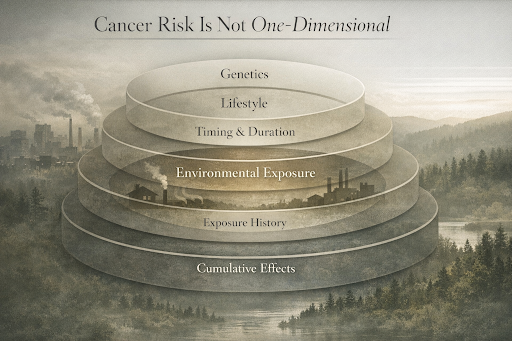
Cancer risk is shaped by multiple influences over time — with environmental exposure representing one often-overlooked part of the bigger picture.
The Exposure Categories That Often Matter Most Aren’t Always the Ones People Focus On
When people picture cancer-related exposure, they often imagine something small and specific,an ingredient on a label, a product on a shelf, a single item to avoid.
But some of the more consequential patterns do not show up in such neat, isolated ways.
They appear in the settings people move through repeatedly: the air they breathe, the buildings they spend time in, the conditions they work in, and the environments that shape long-term contact. The National Cancer Institute includes hazards such as asbestos, benzene, radon, and secondhand tobacco smoke among environmental carcinogens, while IARC has classified outdoor air pollution as carcinogenic to humans. (5)
That matters because it shifts the conversation away from one-off product anxiety and toward a broader view of environmental exposure. In real life, the bigger questions often involve categories such as:
- polluted air
- radon in homes and buildings
- secondhand smoke
- workplace exposure
- industrial contamination in the surrounding environment
- daily stressors and a dysregulated nervous system
This is where the topic starts to sharpen. Environmental exposure is not just about what people buy. It is also about what they breathe, where they spend time, how much stress they experience, and what they come into contact with over the long term.
That broader picture does not make the issue simpler.
It makes it more real.
Risk Has a Long Memory
Not every influence on health leaves an immediate mark.
Some effects are shaped by repetition. Others by duration. Others by the way several factors interact over time. That is part of what makes cancer risk so difficult to reduce to one cause, one event, or one clean explanation.
Environmental exposure often works in that slower register.
What matters is not only what the exposure is, but also how often it happens, how long it continues, how intense it is, and what else is happening alongside it. Dose matters. Timing matters. Context matters. So does the way different influences can overlap rather than act alone.
This is one reason cancer research rarely points to a single answer for every case. The National Cancer Institute explains that cancer develops through genetic changes that build up over time, and that those changes may be influenced by a combination of environmental exposures, lifestyle factors, and inherited traits. (6)
That cumulative model changes the way risk is understood. It shifts the focus away from finding one perfect culprit and toward the patterns that shape long-term health.
Risk, in other words, is often less like a switch and more like a sequence.
And once you see it that way, it becomes easier to understand why environmental exposure deserves a more serious place in the wider cancer-risk conversation.
Why Environmental Exposure Deserves a More Serious Place in the Cancer-Risk Conversation
By this point, the pattern is clear.
Cancer risk is shaped by more than inherited traits or familiar lifestyle factors. It is also influenced by the conditions surrounding people over time, including the exposures woven into the places they live, work, and spend their days.
And yet environmental exposure is still often treated as a side issue: too vague, too complicated, or too easy to push to the margins.
That is what needs to change.
Environmental exposure does not have to explain everything to matter. Its importance lies in the fact that it adds another layer to how long-term health is shaped — and helps make sense of why cancer risk cannot be understood through a short list of familiar causes alone.
That shift is useful, because it changes the question.
Instead of asking only, “What risk factors do I already know about?” A more valuable question is: “What influences on long-term health have I overlooked simply because they were never framed as part of the picture?”
That is where this conversation becomes genuinely worthwhile.
It moves beyond awareness for its own sake and toward something more practical: a clearer way of thinking about risk, a more complete view of what science is examining, and a stronger reason to take environmental exposure seriously.
You do not need to treat it as the whole story.
But it should no longer be treated as a footnote.

A more useful response to environmental risk is not fear, but perspective.
A Smarter Way to Think About Exposure
If environmental exposure deserves a more serious place in the cancer-risk conversation, the next question is how to respond to that idea without slipping into fear or false certainty.
The most useful response is not hypervigilance.
It is perspective.
That means recognising that not every exposure carries the same weight, not every risk can be controlled completely, and not every unanswered question should be treated like an emergency. It also means understanding that paying closer attention to environmental health is not about chasing perfection. It is about becoming more informed, more discerning, and less passive.
That shift matters.
Because once people stop looking for one simple cause or one simple fix, they can begin asking better questions. What has strong evidence behind it? What deserves closer attention? What has been minimised, ignored, or treated as too complicated to matter?
Those questions are far more useful than panic.
They create space for a more mature understanding of risk, one rooted in curiosity, proportion, and a willingness to look beyond the most familiar explanations. And that may be the real value of this conversation: not that it offers one final answer, but that it invites a more complete way of thinking about long-term health.
Conclusion
Cancer risk has never been a simple equation.
It is shaped by many influences at once, some familiar, some less discussed, some easier to measure than others. And that is exactly why environmental exposure deserves more than a passing mention. Not because it explains everything, but because it is too important to keep treating it like a side note.
That may be the real shift this conversation asks for.
Not more panic. Not more confusion. Not a search for one perfect answer.
Just a fuller understanding of the landscape.
Because once you begin to see cancer risk as more than a short list of obvious causes, different questions start to emerge. Better questions. Questions about what has been overlooked, what deserves closer attention, and what role the world around us may be playing in long-term health.
And sometimes, that is where the most important conversations begin.
If this article has opened up questions you have not explored before, you are not alone. For many people, environmental exposure is one of the least understood pieces of the cancer-risk conversation, and one of the most important to look at more closely, especially if its impacting your level of daily stress. That is exactly why this next resource is worth your time. It goes deeper into the overlooked links, the wider patterns, and the questions more people are starting to ask about what may be shaping long-term health behind the scenes.
Download the guide here
Sources
(1) Lichtenstein, S., Slovic, P., Fischhoff, B., Layman, M., & Combs, B.
“Judged Frequency of Lethal Events.” Journal of Experimental Psychology: Human Learning and Memory.
This supports the point that people tend to overestimate vivid, dramatic causes of death and underestimate quieter, less attention-grabbing ones.
(2) Slovic, P., Fischhoff, B., & Lichtenstein, S.
“Behavioral Decision Theory Perspectives on Risk and Safety.” Acta Psychologica (1984).
This supports the broader idea that people do not judge hazards by data alone, and that factors like familiarity, visibility, and delayed effects influence perceived seriousness.
(3) International Agency for Research on Cancer (IARC).
“Agents Classified by the IARC Monographs.”
Use this for the classification categories: carcinogenic to humans, probably carcinogenic, and possibly carcinogenic.
(4) American Cancer Society.
“Known and Probable Human Carcinogens.”
This is the plain-English support for how carcinogens are assessed and why evidence strength matters.
(5) National Cancer Institute.
“Cancer-Causing Substances in the Environment.”
Use this for environmental carcinogens such as asbestos, benzene, radon, and secondhand smoke.
(6) National Cancer Institute.
“Risk Factors for Cancer.”
Use this for the point that cancer develops through genetic changes over time and can be influenced by environmental exposures, lifestyle factors, and inherited traits.