

You’ve probably heard about antioxidants your whole life. But the most powerful one isn’t in your smoothie bowl or supplement drawer. It’s inside you right now, made by your own cells.
Meet glutathione.
In scientific circles, it’s often called the body’s “master antioxidant.” That’s not hype, it’s a reflection of the central role it plays in protecting your cells from oxidative stress, the kind of internal wear and tear that builds up over time.
In this article, we’ll cover:
- What glutathione actually does in the body
- Why oxidative stress may increase with age
- What it can feel like when your antioxidant defenses are under strain
- Practical ways to support healthy glutathione levels
What Is Glutathione?
Glutathione is a natural compound made from three amino acids: glutamine, glycine, and cysteine. You don’t need to remember the chemistry, but here’s what matters: it’s produced inside your body and found inside your cells, where it helps support your antioxidant defenses.
Unlike many nutrients that come from food, glutathione is something your body makes for its own use. It’s not an outsider. It’s part of your internal toolkit for staying resilient.
That’s why it stands out in conversations about cellular health, detox support, and healthy aging. It’s not just another wellness buzzword—it’s a molecule your body already relies on, every day.

What Is Oxidative Stress?
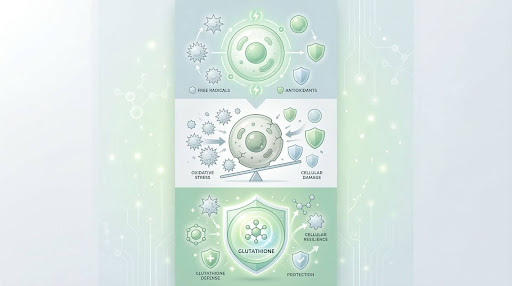
Oxidative stress happens when your body produces more free radicals than it can keep up with. Free radicals aren’t inherently bad—they’re a natural byproduct of energy production, exercise, and environmental exposure. The problem starts when they accumulate faster than your antioxidant defenses can neutralize them.
That imbalance can strain your cells over time.
And in modern life, that strain adds up. Common contributors include:
- Poor sleep
- Chronic stress
- Smoking and alcohol
- Pollution and toxins
- Poor diet
- Overtraining without recovery
None of these alone is a crisis. But when they stack up, the body has more to manage—and that’s when oxidative load becomes more than just a background process. (1)
Why Glutathione Matters More as You Age
Aging isn’t just about what you see on the outside. It’s also about what’s happening inside, years of metabolic activity, environmental exposure, and repair demands adding up.
As we get older, the body may face more oxidative pressure, while some of its defense systems become less efficient. (2) That doesn’t mean everyone becomes deficient. But it does help explain why glutathione is so often discussed in the context of healthy aging.
One study followed older adults over time and found that those with lower glutathione levels tended to develop multiple chronic conditions more quickly. (3) That doesn’t prove low glutathione causes disease, but it suggests this molecule is part of the bigger picture of how we age.
The takeaway? Aging may increase the body’s need for the systems that help protect and repair the body over time. Glutathione is one of those systems.
Signs Your Body May Be Under More Oxidative Stress
You can’t feel an increased oxidative load directly. There’s no single symptom. But it often shows up as a general sense that your body isn’t bouncing back the way it used to.
Maybe you used to bounce back from a late night in one day, now it takes three. Maybe a hard workout leaves you sore for a week instead of two days. Or maybe you just feel like your battery drains faster than it used to. Small disruptions liketravel, stress, and poor sleep hit harder than they once did.
These changes are subtle and nonspecific. They don’t automatically point to glutathione. But they can reflect a body that’s having a harder time keeping up.
The question isn’t whether you have one clear symptom. It’s whether you feel as resilient as you used to.
What Can Increase the Body’s Demand for Glutathione?
Glutathione levels aren’t fixed. They fluctuate based on what the body is dealing with. Factors that can increase demand include:
- Chronic stress
- Aging
- Pollution and toxin exposure
- Poor diet or low nutrient intake
- Illness and inflammation
- Intense exercise without enough recovery
None of these automatically means your glutathione is low. But when stressors pile up, the body may have more to manage behind the scenes. Glutathione becomes more relevant anytime the body is under a heavier load.
How to Support Healthy Glutathione Levels
Because your body makes its own glutathione, supporting healthy levels is less about finding a magic bullet and more about creating the right conditions. In other words, the goal is not to force the body to do something unnatural. It is to give it the raw materials, recovery, and daily support it needs to function well.
Start With Nutrition
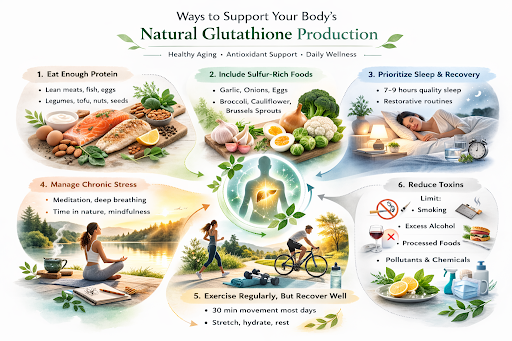
Glutathione is built from amino acids, so getting enough protein matters. Top plant sources include legumes (lentils, soybeans/tofu), nuts and seeds. A nutrient-rich diet helps provide the building blocks the body uses to make and maintain its own antioxidant defenses.
Certain foods are also often discussed in relation to glutathione production, especially those rich in sulfur-containing compounds. These include foods like garlic, onions, and cruciferous vegetables such as broccoli, cauliflower, and Brussels sprouts. Regularly including these kinds of foods can support the body’s natural systems in a simple, food-first way.
A broader whole-food diet matters too. The more consistently you nourish the body, the better equipped it may be to keep up with the demands placed on it.
Protect Recovery
Supporting glutathione is not only about what you eat. It is also about how well your body is able to recover.
Poor sleep, chronic stress, and constant overextension can all increase oxidative load. That means recovery habits matter more than many people realize. Sleep gives the body time to repair. Stress management helps reduce the chronic internal demands that can wear those systems down over time. And even small habits that help the nervous system settle — like walking, slowing down, or spending time away from constant stimulation — can support overall recovery.
This is one reason wellness is often less about one impressive habit and more about the quiet routines that make the body’s job easier day after day.
Move Regularly But Don’t Ignore Recovery
Exercise can support overall health and antioxidant function, but more is not always better. Movement challenges the body in productive ways, but intense training without enough rest can add to the very burden you are trying to manage.
That is why balance matters here. Regular movement can be supportive, but recovery is part of the equation too. The body does not only benefit from exercise itself; it also benefits from having enough time and resources to adapt to it.
Reduce What Adds to the Load
Sometimes support is not only about adding helpful habits. It is also about reducing the things that place extra demand on the body.
That may include limiting smoking, excess alcohol, and avoidable toxin exposure where possible. It may also mean taking a more honest look at the everyday patterns that keep the body under constant strain, whether that is poor sleep, high stress, a chaotic diet, or never fully recovering between busy periods.
These are not glamorous habits, but they are often the ones that matter most over time.
Where Supplementation Fits In
Some people also turn to supplementation as part of a broader healthy-aging or antioxidant-support routine. (4)That can be especially appealing when life feels unusually demanding or when someone wants a more intentional way to support their antioxidant defenses.
Supplementation works best when it is approached realistically. A few useful things to keep in mind are:
- it works best alongside a strong foundation, not instead of one
- consistency matters more than complexity
- delivery format can shape convenience and user experience
- different people may prefer different formats depending on what they will actually use
Research suggests certain forms of oral glutathione may help increase stores under the right conditions. Delivery format may also play a role in how effectively a supplement supports glutathione status, which is why options like liposomal and sublingual forms are often discussed alongside traditional capsules.
At the end of the day, the best supplement routine is usually the one that feels simple enough to use consistently.
The Bottom Line
Glutathione won’t stop time or erase stress. But it is one of the body’s most fundamental tools for managing both. And in a world that asks more of your cells than ever, giving your body what it needs to keep that tool working well? That’s not hype. That’s just smart support.
Key Takeaways
- Glutathione is your body’s master antioxidant, made inside your cells.
- Oxidative stress is normal but can build up with age, stress, and lifestyle.
- You can support glutathione with protein, sulfur-rich foods, sleep, and recovery.
- If you supplement, delivery format matters—look for forms designed for absorption.
Start Here
References
- Sies H. Oxidative Stress: Concept and Some Practical Aspects. Antioxidants. 2020;9(9):852.
- Detcheverry F, et al. Changes in levels of the antioxidant glutathione in brain and blood across the age span of healthy adults. NeuroImage: Clinical. 2023;40:103503.
- Pérez LM, et al. Glutathione Serum Levels and Rate of Multimorbidity Development in Older Adults. The Journals of Gerontology: Series A. 2020;75(6):1089-1094.
- Richie JP Jr, et al. Randomized controlled trial of oral glutathione supplementation on body stores of glutathione. European Journal of Nutrition. 2015;54(2):251-263.