

Most people think of cancer as something that appears quietly and grows without resistance. But that is not the full story. Your body is equipped with an extraordinary defense system that works around the clock to monitor for threats, respond to damage, and help protect you from abnormal cells. That is one reason the relationship between the immune system and cancer has become such an important area of focus for researchers, doctors, and people looking for better ways to support the body during cancer.
At any given moment, your immune system is doing far more than fighting off colds and viruses. It is constantly scanning, communicating, and responding. Specialized immune cells, including natural killer cells and other white blood cells, help identify cells that are damaged, unhealthy, or behaving in ways they should not. When immune defenses are strong and working well, this internal protection system can play a powerful role in the body’s ability to recognize and respond to potential threats.
This is why the role of the immune system during cancer has become such an important conversation. A cancer diagnosis places enormous stress on the body, and many people are left wondering how to support their immune system, strengthen their resilience, and give their body the help it needs during a difficult time. More people are asking how the immune system fights cancer, what causes those defenses to weaken, and what steps may help support immune health in a more meaningful way.
The good news is that we are learning more than ever about how the immune system interacts with cancer cells, why immune defenses matter, and how supporting the body’s natural protection systems may play an important role during cancer.
What Does the Immune System Have to Do With Cancer?
One of the immune system’s most important jobs is to protect the body by constantly watching for anything that does not belong. That includes viruses, bacteria, toxins, and even cells inside the body that have become damaged or abnormal. In other words, the immune system does not only respond to outside threats. It also helps monitor what is happening within.
This is where the connection between the immune system and cancer becomes so important. Cancer often begins when certain cells start behaving in ways they should not. Instead of growing, dividing, and dying in an orderly pattern, they begin to change and multiply abnormally. Part of the body’s natural defense system is designed to notice those changes. This process is often referred to as immune surveillance — the way the immune system detects abnormal cells and helps protect the body from potential harm.
Scientists sometimes describe this more broadly as cancer immunoediting — the idea that the immune system can eliminate some potentially cancerous cells, keep others in check, and, in some cases, be outmaneuvered as cancer learns to escape detection. (1)
When people ask how the body fights cancer naturally, this is part of the answer. The immune system and cancer cells are closely connected because the body is built to identify problems early and respond. That is also why immune-focused research and treatment strategies have become such an important part of the cancer conversation. The more we understand how immune defenses work, the more we can understand why supporting them matters.
How Your Body Naturally Identifies and Attacks Abnormal Cells
One of the most fascinating things about the immune system is that it is not just sitting quietly in the background. It is active, alert, and constantly working to identify cells that seem damaged, unhealthy, or out of place. When people ask how the immune system fights cancer cells, this is where the story really begins.
Natural Killer Cells: Your Body’s First Responders
A key part of that story involves natural killer cells, often called NK cells. These are some of the immune system’s front-line defenders. Their job is to move through the body looking for cells that appear abnormal or dangerous. Unlike some other immune responses that take time to build, natural killer cells can respond quickly. That is one reason natural killer cells and cancer have become such an important area of interest. They are part of the body’s built-in ability to recognize trouble early and act fast.
Researchers continue to study NK cells closely because they are considered one of the immune system’s important early defenders against potentially dangerous cells.
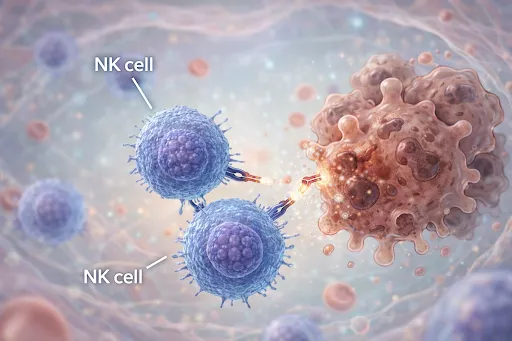 Illustration of how natural killer cells and other immune defenses help the body respond to unhealthy cells.
More Than One Line of Defense
But NK cells are not working alone. The immune system has multiple layers of defense, and several different immune cells help protect the body. White blood cells are part of that larger defense network, helping the body respond to threats and coordinate immune activity. Some help identify a problem, while others help signal for backup or clear away damaged material.
T cells are another important piece of the puzzle. In simple terms, T cells help the immune system recognize specific threats and mount a more targeted response. This is part of why conversations around T cells and cancer have become so important in modern cancer research. They help show just how intelligent and adaptive the immune system can be.
Together, these immune defenses help the body:
- recognize cells that are damaged or abnormal
- respond quickly to potential threats
- coordinate a more targeted immune response
- protect the body through multiple layers of defense
That is part of how the body fights cancer naturally, and why supporting immune health can matter so much during cancer.
If the Immune System Fights Cancer, Why Does Cancer Still Develop?
If the immune system is designed to recognize unhealthy cells, it is only natural to wonder why cancer still develops at all. The answer is not that the immune system is unimportant. In fact, the opposite is true. The immune system matters so much because cancer often becomes more dangerous when it finds ways to get past the body’s natural defenses.
Cancer Can Adapt and Become Harder to Detect
Cancer is complex, and it does not stay the same over time. As abnormal cells change, they can become less visible to immune defenses or create conditions that make it harder for the body to respond effectively. Scientists sometimes describe this as cancer immunoediting — a process in which the immune system may eliminate some unhealthy cells, keep others in check, and in some cases face cells that eventually learn to escape detection.
This helps explain how cancer evades the immune system and why cancer still develops even in a body that is built to protect itself.
Why This Still Points Back to Immune Health
Rather than weakening the role of the immune system, this actually shows how central it is. The issue is not whether immune defenses matter. The issue is that cancer is highly adaptive, and the body may need more support when those defenses are being challenged.
That is one reason this conversation matters so much. The more we understand about how cancer and the immune system interact, the clearer it becomes why immune health deserves attention.
Why Immune Support Matters During Cancer Treatment
Cancer treatment can affect how a person feels physically, emotionally, and mentally from day to day. Many people are trying to manage fatigue, disrupted sleep, stress, poor appetite, and the ongoing demands of appointments, decisions, and recovery. That is why the role of the immune system can feel especially important during cancer treatment. It is not just about protection. It is also about helping the body feel more supported through an incredibly demanding time.
When the body is carrying that much, even the basics can become harder. Rest may not feel fully restorative. Eating well may take more effort. Stress can become exhausting in its own right. This is one reason supporting the immune system during cancer matters in such a practical way. Immune health is closely tied to strength, recovery, and the body’s ability to keep going when a lot is being asked of it.
For many people, learning about cancer treatment and immune health is not about doing everything perfectly. It is about understanding how to care for the body more intentionally, so it feels less overwhelmed and better supported.
What Can Help Support Immune Health During Cancer?
When people start asking how to support immune health during cancer, they are often hoping for one clear answer. But in reality, immune support usually comes from a combination of steady, foundational things that help the body cope, recover, and stay resilient. It does not have to be perfect to be meaningful. In many cases, small forms of support can still make a real difference.
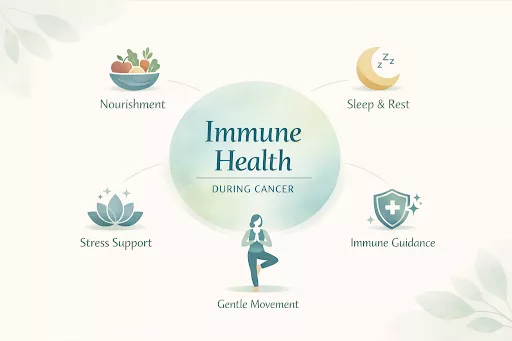
Supportive foundations may include:
- nourishing meals and hydration where possible
- rest and better-quality sleep
- stress support and emotional steadiness
- nervous system regulation
- gentle movement when appropriate
- better information and more intentional questions about immune health
Start With the Basics That Strengthen the Body
Nutrition is one of the most important places to begin. During cancer, the body needs nourishment to maintain strength, support repair, and keep up with the physical demands it is facing. That does not mean eating perfectly. It means doing what you can to support intake, hydration, and nourishment in a realistic way. Sleep and rest matter just as much. When the body is exhausted, everything feels harder, and immune health during chemotherapy or other treatment can feel even more strained.
Support the Whole Environment Around Healing
Stress management matters too, not because stress causes cancer, but because prolonged stress can leave the body feeling depleted. Creating more moments of calm, support, and emotional steadiness can be part of natural immune support during cancer. The same is true for gentle movement, when appropriate. For some people, that may mean a walk, stretching, or simply finding safe ways to keep the body from becoming completely shut down by fatigue.
A supportive healing environment also includes the information you take in and the questions you ask. Many people feel more empowered when they begin learning about integrative support for cancer patients and understanding what may help strengthen the immune system during cancer treatment in a more complete way.
Getting to the root cause of stress in the body is essential which almost always goes back to earlier years in our life when our nervous system learned how to be on high alert due to childhood adverse experiences, traumas, negative belief systems, and challenging situations we had to adapt to, but never fully heal. For more details on this, read my blog about The AWAKEN Process™ for Cancer.
The goal is not to do everything perfectly. It is to support the body where you can, in ways that are realistic, nourishing, and sustainable. That is often where real progress begins.
What About Beta Glucan and Immune Training?
As researchers continue learning more about the immune system and cancer, more attention is being given to the idea that immune defenses may not just need support — they may also need the right kind of stimulation and communication. That is where conversations around beta glucan immune support and immune training have become especially interesting.
In simple terms, immune training refers to helping the immune system stay more alert, responsive, and ready to act. In research settings, scientists have used the term trained immunity to describe how compounds such as beta glucan may help prime parts of the innate immune system to respond more effectively. It is not about forcing the body into overdrive. It is about supporting immune communication so the body’s natural defenses are better prepared to respond when needed. For someone facing cancer, that idea can be especially meaningful, because immune resilience becomes such an important part of the bigger picture. (3)
This is one reason beta glucan and cancer has become a growing area of interest. Beta glucan is a natural compound that has drawn attention for its potential role in supporting immune readiness and helping key immune cells stay engaged. It is also part of the broader conversation around natural killer cells support, since NK cells are among the body’s important front-line defenders.
For many people, this opens up an entirely new way of thinking about immune health. Instead of seeing the immune system as something that is either strong or weak, the conversation becomes more nuanced. It becomes about how the body communicates, adapts, and stays prepared. And that is what makes ideas like beta glucan and immune training so worth exploring.
Supporting Your Immune System Is About More Than One Thing
Supporting your immune system during cancer is not about chasing one magic answer. It is about understanding that immune health is connected to many parts of the healing experience, including nourishment, rest, recovery, emotional wellbeing, and the support the body receives along the way.
That is why whole-body immune support matters. The immune system does not work in isolation, and neither does healing. For many people, this is what makes immune resilience during cancer and integrative cancer support feel so meaningful. A more complete approach can help people feel better informed, better supported, and more empowered.
Sometimes that shift in perspective is where real change begins.
Want to Learn More About How to Support Your Immune Defenses During Cancer?
If this conversation has sparked new questions, that can be a powerful place to begin. The more you understand about how the immune system fights cancer, why those defenses can come under strain, and what may help support immune defenses during cancer, the more confident and informed you can feel as you explore your options.
For many people, the next step is learning more about immune health, integrative cancer support, and the ways the body may be supported more intentionally during a difficult time. Dr. Stegall’s work helps bring these ideas together in a practical, easy-to-understand way, making complex topics feel more approachable and relevant.
Sometimes real empowerment starts with better information, a clearer perspective, and a deeper understanding of what may help support the body’s natural defenses.
Frequently Asked Questions About Immune Support During Cancer
Can you support your immune system during cancer treatment?
Yes, many people look for ways to support immune health during cancer treatment through nutrition, rest, stress management, gentle movement, and a more supportive healing environment. The goal is not perfection. It is to help the body stay as nourished, resilient, and supported as possible during a physically demanding time.
What weakens the immune system during cancer?
Several factors can place extra strain on the body during cancer, including emotional stress, poor sleep, fatigue, inflammation, low appetite, and the demands of treatment itself. This is one reason supporting immune resilience during cancer matters so much.
Is immune support only about supplements?
No. Supplements may be part of the conversation, but whole-body immune support goes far beyond that. Immune health is also influenced by nourishment, recovery, sleep, emotional wellbeing, movement, and the overall support the body receives during cancer.
What is immune training in simple terms?
Immune training refers to helping the immune system stay alert, responsive, and ready to act. Rather than trying to push the body into overdrive, the idea is to support immune communication and readiness so natural defenses are better prepared to respond when needed.
Why are people talking about beta glucan and immune health?
Beta glucan has gained attention because it is being explored for its potential role in beta glucan immune support, immune communication, and immune readiness. For many people, it has become part of a larger conversation about natural ways to support immune defenses during cancer.

Conclusion
The immune system plays a deeply important role in how the body responds to abnormal cells, protects overall health, and navigates the challenges of cancer. That is why the connection between the immune system and cancer deserves real attention.
Cancer can place the body under strain in many different ways, which is why support matters. From nourishment and rest to immune resilience, natural killer cells, and the growing interest in beta glucan immune support, there is a lot to learn about how the body may be supported more intentionally during this time.
What matters most is not finding one perfect answer. It is understanding that there are meaningful ways to care for the body, ask better questions, and explore support more thoughtfully. And for many people, that alone can bring a greater sense of clarity, hope, and empowerment.
Start Here
References
(1) Schreiber, Old, Smyth, Cancer Immunoediting: Integrating Immunity’s Roles in Cancer Suppression and Promotion (Science, 2011).
(2) Natural killer cell-mediated immune surveillance in cancer (2024 review).
(3) Kalafati et al., Innate Immune Training of Granulopoiesis Promotes Anti-tumor Activity (Cell, 2020).